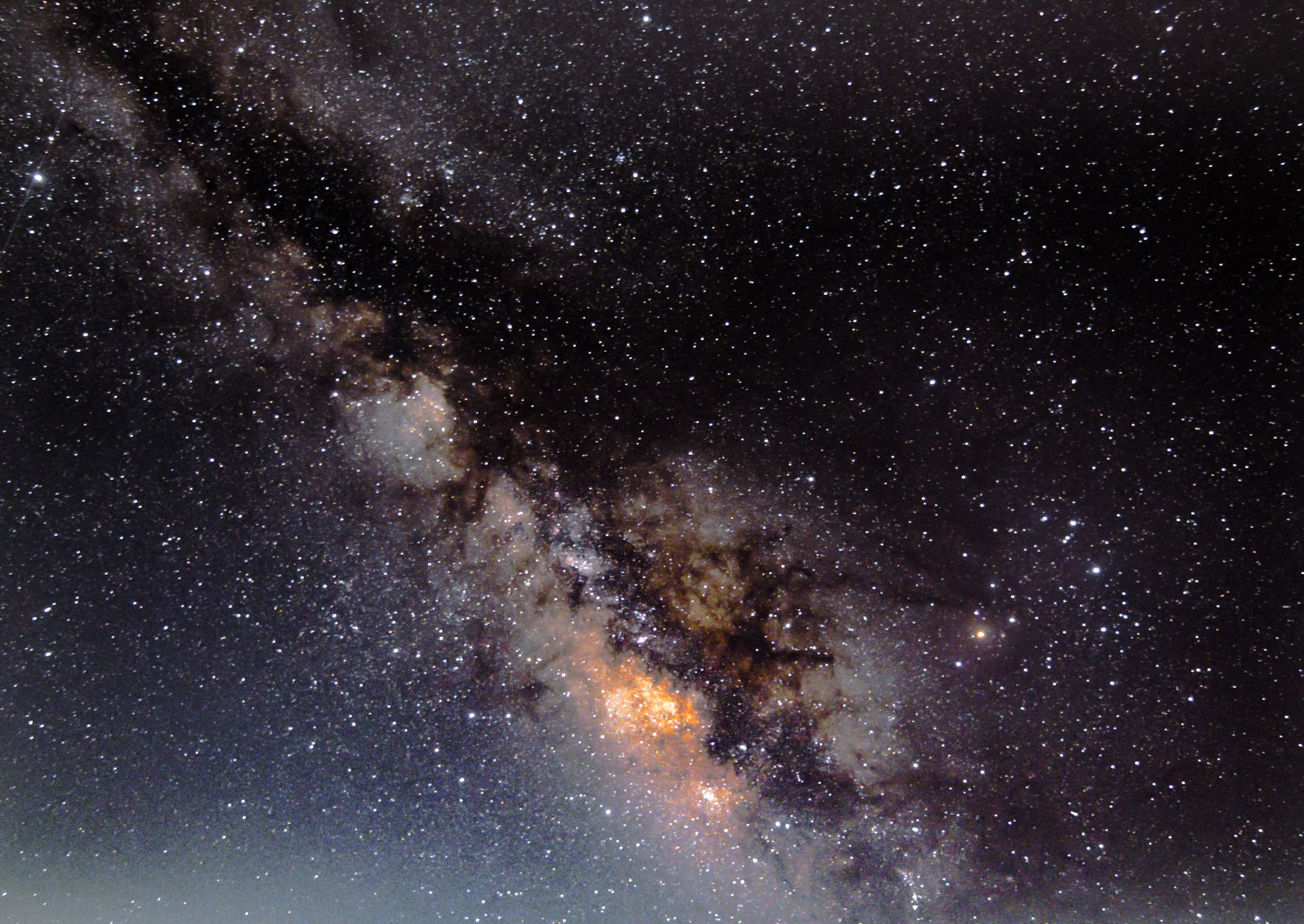
A significant mystery in astronomy, the Galactic Center Excess, continues to be investigated, with recent research unable to exclude self-annihilating dark matter as the source of a pervasive gamma-ray glow emanating from the Milky Way’s core.
This high-energy light, observed as a spherical emission extending thousands of light-years from the galactic center, has puzzled scientists for over a decade. While explanations such as populations of pulsars, a type of rapidly spinning neutron star, have been proposed, a leading hypothesis involves a specific kind of dark matter particle.
Dark matter, which constitutes about 85% of the universe’s matter, is invisible as it does not interact with light or ordinary atomic matter. This characteristic has led to the proposal of numerous candidate particles, including those that could self-annihilate. This process is similar to how an electron and its antimatter counterpart, a positron, annihilate each other upon meeting, releasing energy.
In the case of self-annihilating dark matter, these particles would act as their own antiparticles. When they interact, they would annihilate, converting their mass into energy and emitting gamma rays. Given that dark matter is five times more abundant than ordinary matter, one might expect a constant flood of gamma rays. However, current models suggest dark matter rarely interacts with itself, making annihilation a significant factor primarily in densely packed regions like a galaxy’s center.
Challenges in Observation
Observing the heart of the Milky Way presents considerable difficulties. Florian List, a researcher at the University of Vienna and a team member, noted that interpreting the signal is especially challenging due to the galactic center being an exceptionally bright and crowded area for gamma-ray detection.
Machine Learning Analysis
To examine the possibility of annihilating dark matter being responsible for the Galactic Center Excess, List and his colleagues employed machine learning techniques. They trained their models on over a million simulated gamma-ray observations. Earlier studies using similar methods had suggested that relatively bright, unresolved light sources could be the origin. However, this new research indicates that such point sources, including pulsars, would need to be exceedingly faint.
This finding is significant for proponents of the dark matter theory. While previous research suggested a few hundred pulsars could account for the excess, the new analysis implies that the pulsar population at the galactic center would need to exceed 35,000 to produce the observed emissions. Nick Rodd, a scientist at the Lawrence Berkeley National Laboratory and another team member, stated that the analysis shows the sources would have to be so faint they would be nearly indistinguishable from the emission expected from annihilating dark matter.
While this research keeps dark matter in contention as a plausible explanation, it does not confirm it as the definitive source of the Galactic Center Excess. List commented that the origin of this excess is one of astrophysics’ longest-standing debates, and while their work does not prove dark matter’s responsibility, it suggests it is premature to dismiss the possibility.
The team’s findings were published on February 5 in the journal Physical Review Letters.

Helene Elliott is the Lead Science & Space Reporter at News Raise. She reports on aerospace missions, astrophysics discoveries, quantum research, and environmental technology.